The Quad Exercise
Had he not been so busy starting a spiritual revolution of love and peace, Jesus probably would have been an excellent psychotherapist. Some of his last words were “Watch and pray that you do not fall into temptation, for the spirit is willing but the body is weak.”
What this insightful comment means on a day to day level is that we sometimes try to make a healthy change in our life and yet there are so many unseen psychological forces working against that change. Think about it, is there some addiction you can’t quit, some hangup that you can’t seem to let go of, some relational dynamic you fall into again and again? Does history tend to repeat itself? Do you notice a tendency towards self-sabotage? All these point to a current of underlying forces that are maintaining an unhealthy status quo.
People don’t come see a therapist when everything is going great. Rarely have I had a brand new client say, “Life is excellent right now and I just wanted to come in and tell somebody.”
My clients often come in a moment of crisis - their marriage is failing, their addiction is out of control, they’re losing friends, family, or a career because of poor choices. In these low moments it is easy to see why change is needed and how their addiction, habit, or pattern is negatively affecting their life.
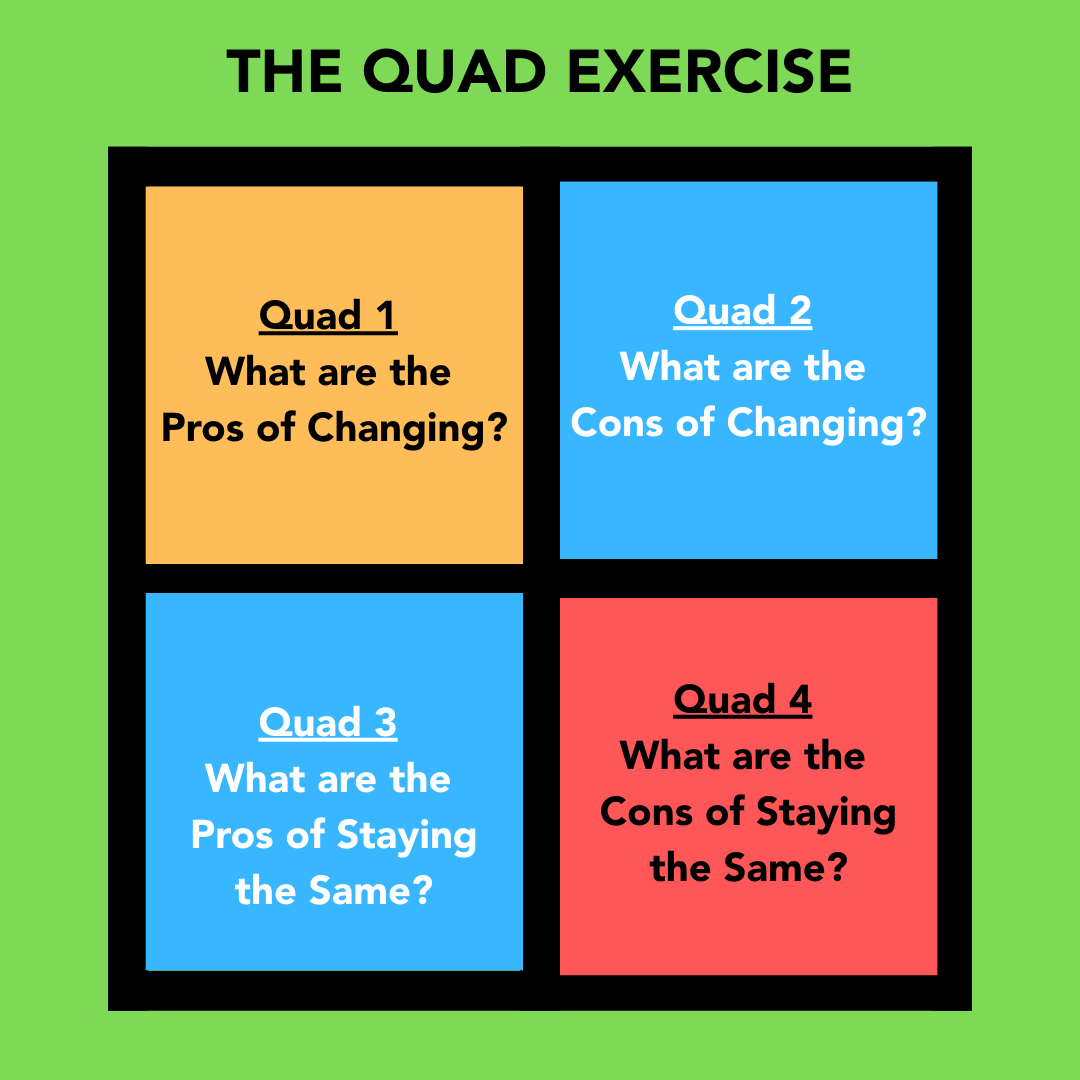
A mental health tool that I’ve found helpful for facilitating change when there seems to be a lot of internal resistance is The Quad Exercise. Though quite simple, it can be helpful for understanding the underlying dynamics that work against making long-term, healthy changes. It looks like this:
If the person is in a difficult situation or if a lot of damage has been done to their life due to their addiction, pattern or hangup it can be quite quick and easy to fill out Quadrants 1 & 4.
Quadrant 1 is asking “What will be better if I make this healthy change and choose to take my life in a new direction?” Quadrant 4 is asking “How will things get worse if I don’t make a change?” Again, these are fairly straightforward to answer. The fact that the person came to counseling says that some desire for change is already present.
The real deep work takes place in Quadrants 2 & 3 and filling in these two sections can take a long time.
Arnold Schwarzenegger famously said “No pain. No gain.” Building muscle requires the tearing down of old tissue to rebuild the new, and that tearing down process is painful. Quadrant 2 is essentially asking “What is the cost I will incur to make this change?” Answering this question is key to maintaining motivation through the change process. To take life in a new and healthier direction involves some sacrifice, we say ‘no’ to some things so that we may say ‘yes’ to others.
What are some common sacrifices people make in order to follow a healthier path in life? Examples include a change in your friend group after deciding to get sober, letting go of a high-paced job to focus more on relationships in your family, facing all the difficulties that have piled up in your life instead of numbing out through drugs, alcohol, video games, sports, etc. You may need to slow down and face your demons, and that is very scary work indeed!
But if you don’t understand the cost of change, if it lurks beneath the conscious surface, it will be difficult to make a lasting change.

Quadrant 3 asks “What are the pros of things staying the same?” In other words “What is the payoff I get from this thing that I seemingly want to change, but am unable to change at this time?”
A lot of clients in their moment of crisis will say “It does nothing for me! It’s destroying my life and ruining everything!” It can be counterintuitive to name the positive aspects of a destructive behavior, but it is important to understand what purpose that destructive behavior serves in the person’s life. Unwanted patterns or behaviors could provide a sense of comfort, security, protection, or escape. Only by naming the positive parts of something negative can we truly understand why it is so hard to change.
Finally, we must speak of the role of trauma in the change process. Unhealed trauma can be a big impediment to making lasting changes. If trauma is deep and occurred early in a person's life their adult reactions to being triggered can be baffling to those around them. Yet, people’s behavior always makes sense if you know the whole picture. In moments of trauma the mind and body adapt to offer protection, these adaptive responses while helpful in the moment can become maladaptive later in life and in other circumstances.
In his book Lost Connections: Why You’re Depressed and How to Find Hope, Johann Hari talks about the work of Dr. Vincent Felitti with weight loss and trauma. Dr. Felitti was running a weight loss clinic in the 1980s for patients struggling with severe obesity. He was using novel methods for weight loss that were showing marked success. Yet counterintuitively, many of the patients were thrown into a deep depression, struggled with severe anxiety or had rageful outbursts after their dramatic weight loss. It was puzzling.
Digging deeper Dr. Ferlitti discovered from conversations with his patients that many had been the victims of some kind of trauma or abuse - women who had been raped and men who had been viciously assaulted. Carrying this “extra weight” was a protective factor for them and losing it unearthed the unprocessed trauma underneath. This is one example of how changing and maintaining new circumstances can be difficult when there’s unhealed trauma underneath.

We may want to change, but change is not easy. When it comes to embarking in a new direction we must understand the underlying forces that discourage us from making the transition and those that incentive us to stay exactly the same.
***FRIENDLY REMINDER: I am licensed to see clients in Michigan and Colorado. If you want to go deeper into what this article is talking about contact me at Grace Counseling: dfralick@gracecounseling.net